- All
- Product Name
- Product Keyword
- Product Model
- Product Summary
- Product Description
- Multi Field Search
Views: 13 Author: Lips Publish Time: 2026-07-20 Origin: sales@eastimage.com.cn


Facility managers face a constant operational tension: balancing rigorous security screening mandates with the need for high-throughput, frictionless foot traffic. Procuring the wrong baggage scanner results in high false-alarm rates, operator fatigue, severe operational bottlenecks, and potential compliance failures. When checkpoints back up, security personnel rush, and the probability of missed threats increases exponentially. Choosing the right equipment requires moving beyond basic specifications to understand how advanced imaging, processing power, and software tools directly impact daily operations on the floor.
This technical evaluation guide details the specific hardware and software features procurement teams must mandate when comparing enterprise-grade X-Ray Scanner Machines. By understanding the core detection capabilities and throughput efficiencies, organizations can deploy systems that maintain strict security perimeters without compromising operational speed. We will break down the exact specifications needed to handle peak volumes while maintaining absolute detection accuracy.

Detection Accuracy Relies on Dual-Energy: Single-energy machines are obsolete for complex security; dual-energy is mandatory for distinguishing between organic (explosives/contraband) and inorganic (metals) materials.
Throughput is Dictated by Hardware Specs: Tunnel size, conveyor speed, and generator voltage must directly align with your facility’s peak-hour baggage volume and item dimensions.
Operator Software is a Force Multiplier: Advanced image manipulation, multi-color palettes, and Threat Image Projection (TIP) are critical for reducing human error and maintaining operator vigilance.
Compliance is Non-Negotiable: Shortlisted machines must meet regional regulatory standards (e.g., TSA, ECAC) and strict radiation safety thresholds.
Table of Contents
A facility's specific threat profile dictates the necessary technical specifications. A courthouse screening for weapons requires different capabilities than a customs checkpoint targeting narcotics or agricultural contraband. Identifying whether your primary threats are dense metals, organic compounds, or complex electronics establishes the baseline requirements for penetration and material differentiation. You must map your hardware choices directly to the items you expect to intercept.
There is a constant trade-off between high-penetration scanning and rapid conveyor speeds. High-penetration generators ensure dense parcels are thoroughly scanned, but processing complex images takes time. Establishing baseline metrics for acceptable processing times ensures the checkpoint can handle peak volumes without creating unacceptable queues. If your facility processes thousands of bags per hour, you need a system that renders images instantly without lag.
Dual-energy X-ray transmission separates materials by their atomic number (Z-number). The system uses two distinct energy levels to measure how different materials absorb X-rays. This allows the software to calculate the material composition of the scanned items, providing critical data for threat identification. Single-energy systems only show shapes and density, making them entirely inadequate for modern security environments where threats are often disguised as everyday items.
Modern security operations have shifted from obsolete 3-color imaging to advanced 4-color and 6-color palettes. This provides precise material identification, allowing operators to distinguish subtle differences in density and composition. The operational outcome is the ability to color-code materials accurately to prevent missed threats.
Material Category | Standard Color Code | Common Examples |
|---|---|---|
Organic | Orange | Plastics, food, paper, explosives, narcotics |
Inorganic | Blue | Steel, iron, thick metals, weapons |
Mixed / Light Metals | Green | Aluminum, glass, complex electronics |
Highly Dense | Black / Opaque | Lead shielding, thick steel blocks |
Standard penetration metrics define a machine's ability to see through dense objects, typically measured by the ability to penetrate 35mm to 40mm of steel. High-penetration ensures dense parcels are thoroughly scanned, preventing threats from being hidden behind thick metal shielding. If the penetration voltage is insufficient for the facility's typical baggage density, the risk of false negatives increases significantly. Operators will see a black mass on the screen and will be forced to manually open the bag, destroying throughput metrics.
Wire resolution, measured in AWG (American Wire Gauge), impacts the clarity of fine wires used in detonators. Modern X-Ray Scanner Machines typically target 38 AWG to 40 AWG, ensuring operators can detect the intricate components of improvised explosive devices. The higher the AWG number, the thinner the wire the machine can resolve on screen.
Advanced software algorithms calculate the effective atomic number (Z-eff) to instantly flag specific organic compounds, explosives, or narcotics. This automated analysis provides a critical layer of security, highlighting potential threats that might be missed by visual inspection alone. When the software detects a Z-eff signature matching a known explosive, it alerts the operator immediately, usually by highlighting the object in a flashing red box.
Advanced, software-driven material stripping allows operators to remove organic or inorganic layers on-screen to isolate hidden threats. This is a significant upgrade over basic color mapping, providing the tools necessary to analyze complex, cluttered bags effectively. If a weapon is hidden behind a thick plastic casing, the operator can strip away the organic orange layer to reveal the blue metallic shape underneath.
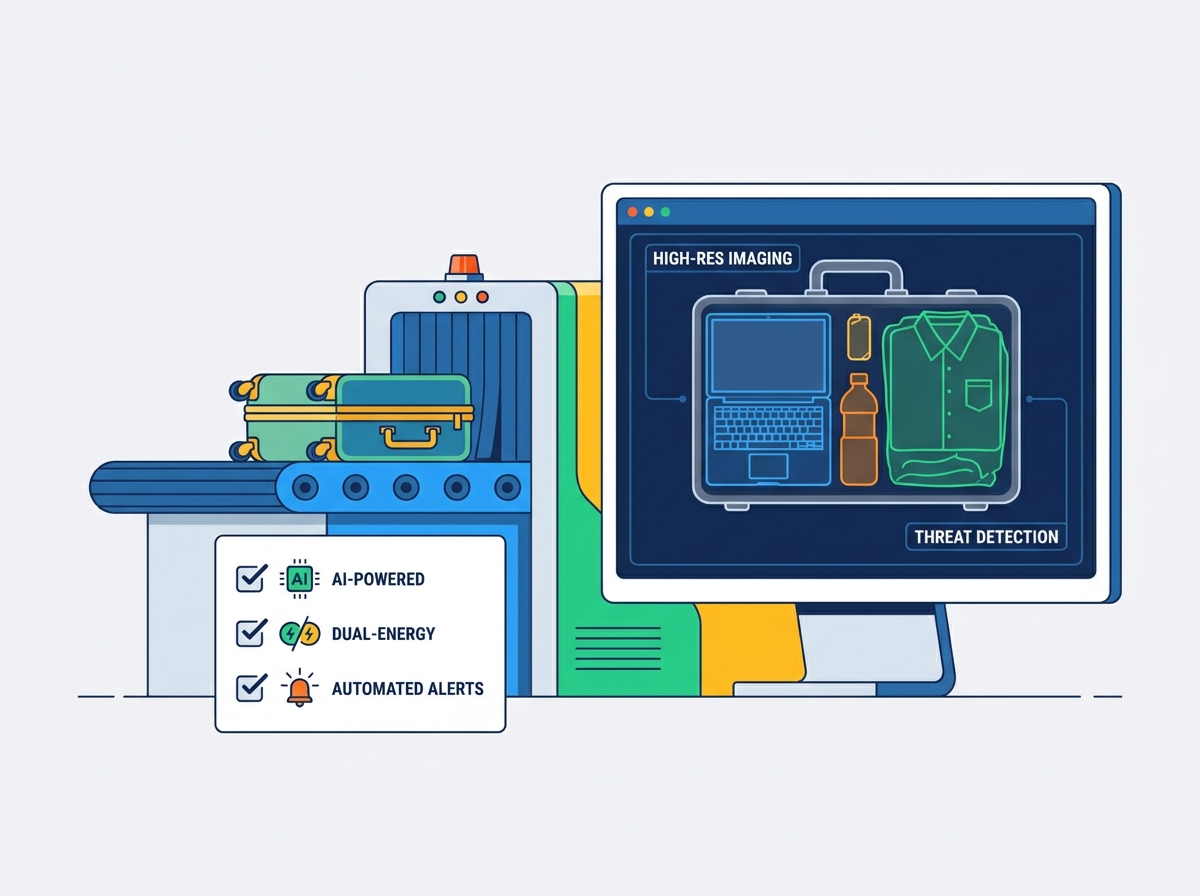
Threat Image Projection (TIP) is a software feature that artificially projects virtual threat objects, such as guns, knives, or explosive devices, into routine baggage scans. This tests and tracks operator alertness, ensuring they remain vigilant during long shifts. TIP is often necessary for regulatory compliance, performance auditing, and continuous operator training. When an operator correctly identifies a TIP object, the system logs the success; if they miss it, the system records the failure for retraining purposes.
AI-Powered Automated Target Recognition (ATR) uses machine-learning algorithms to automatically scan, identify, and frame-box suspicious objects. This assists human operators by highlighting potential weapons, liquids, or aerosols, minimizing fatigue and improving overall detection rates. ATR acts as a second set of eyes, constantly scanning every pixel without suffering from the fatigue that affects human operators after hours of staring at a monitor.
Standard tunnel sizes are categorized based on the intended application. You must match the physical dimensions of the machine to the actual items you process daily. A 50x30 cm tunnel is suitable for mail and purses, while a 60x40 cm tunnel accommodates standard cabin baggage. For cargo and oversized baggage, a 100x100 cm tunnel or larger is required.
Matching the tunnel size to the facility's largest expected standard parcel avoids offloading bottlenecks. Forcing oversized items through an undersized scanner damages equipment and slows down the entire screening process. If a bag gets stuck, the entire line stops while personnel clear the jam.
Tunnel Size (W x H) | Primary Application | Typical Environment |
|---|---|---|
50 x 30 cm | Mail, small parcels, purses | Corporate lobbies, mailrooms |
60 x 40 cm | Cabin baggage, backpacks | Airport checkpoints, courthouses |
100 x 100 cm | Oversized luggage, small cargo | Customs, logistics hubs |
150 x 150 cm+ | Palletized cargo, large freight | Air cargo facilities, seaports |
Standard conveyor speeds typically range from 0.20 to 0.23 meters per second. This speed directly translates to items-per-hour throughput, determining how quickly a checkpoint can process traffic. Maximum load capacities, often 150kg to 200kg evenly distributed, ensure the system can handle heavy items without straining the drive mechanics.
Under-speccing the motor for heavy cargo environments introduces mechanical risks. A conveyor system that struggles under heavy loads will experience frequent breakdowns, causing unacceptable downtime. You need industrial-grade motors and reinforced rollers if you plan to scan heavy toolboxes or dense freight.
Standard 140kV generators provide sufficient penetration for basic screening, while high-penetration 160kV or 180kV generators offer better depth penetration for dense cargo. Higher voltage correlates directly to the ability to see through thick materials. If you are scanning thick metal containers, a 140kV generator will simply bounce off, providing zero internal visibility.
The critical difference between Single-View and Dual-View systems lies in the perspective provided. Dual-View systems generate horizontal and vertical perspectives simultaneously. This eliminates the need to physically reposition and rescan bags, drastically improving throughput and the detection of flat threats. A knife laid flat might be invisible from a top-down view but will show up clearly on the side-view monitor.
Low-latency image processing pipelines are essential for transitioning raw sensor signals into digital images on-screen with zero lag at high conveyor speeds. Operators rely on real-time image manipulation and filtering tools, including continuous zoom (up to 64x), edge enhancement, sharpening, inverse imaging (black/white), and high/low penetration filtering.
The ergonomic impact of the control console and image processing latency directly affects operator fatigue during long shifts. Smooth, responsive software allows operators to analyze images quickly and accurately without frustration. If the software stutters or takes two seconds to apply a filter, the operator will stop using the filters, compromising security.
Centralized network integration connects multiple scanners to a single supervisory server. This allows for remote archiving, centralized TIP management, and multiplexing, where remote operators review images from multiple machines from a central control room. This architecture improves efficiency and standardizes screening protocols across a facility.
By pulling operators off the noisy checkpoint floor and placing them in a quiet, climate-controlled multiplexing room, you reduce distractions and improve detection rates. The network also allows supervisors to push software updates and new TIP libraries to all machines simultaneously.
Strict radiation leakage standards dictate that emissions must be less than 0.1 µSv/h at 10 cm from the housing. Physical safety features like double-layer lead-impregnated curtains, emergency stop buttons, and interlock switches ensure operator and public safety. If a hand enters the tunnel, the interlock switches must immediately cut power to the generator.
Procurement teams must verify key certifications, such as FDA/CDRH, CE, TSA qualification, or ECAC standard compliance. Radiation detection systems integrated within the scanner housing monitor real-time radiation safety levels, providing continuous verification of safe operation. Never deploy a machine that lacks proper regional compliance documentation.
Site preparation constraints must be addressed before installation. This includes evaluating the physical footprint, floor load-bearing requirements, and power supply stability. Failing to prepare the site adequately leads to installation delays and operational issues. Heavy scanners require reinforced flooring and dedicated electrical circuits to prevent power fluctuations from damaging the sensitive imaging sensors.
Operator adoption and training are critical for maximizing the value of advanced features. Poor training leads to underutilization of the equipment. Mandating vendor-supplied certification programs ensures operators understand how to use material differentiation and filtering tools effectively. A machine is only as good as the person reading the screen.
Service Level Agreements (SLAs) are necessary for routine calibration, generator replacement, and software patching. Proactive maintenance minimizes downtime and ensures the equipment continues to operate at peak performance. X-ray generators degrade over time and require periodic recalibration to maintain image clarity and penetration metrics.
Choosing the right X-Ray Scanner Machines is critical for achieving reliable threat detection, efficient screening operations, and long-term regulatory compliance. Evaluating both hardware performance and intelligent software capabilities helps organizations build safer, faster, and more effective security inspection systems.
At Eastimage, we specialize in advanced X-ray security inspection systems for airports, customs, logistics, government facilities, and critical infrastructure worldwide. Our innovative screening technologies and professional technical support help customers improve detection accuracy, operational efficiency, and compliance with international security standards.
Before investing in X-Ray Scanner Machines, carefully evaluate your screening environment, throughput requirements, threat profile, future expansion needs, and software capabilities to ensure the most effective long-term security solution.
A: Dual-view scanners generate two distinct angles (horizontal and vertical) simultaneously. This prevents blind spots, improves the detection of flat threats, and significantly reduces the need to physically reposition and rescan bags, thereby increasing throughput.
A: Standard color mapping uses orange for organic materials (like plastics, food, or explosives), blue for inorganic materials (like dense metals), green for mixed materials or light metals, and black for highly dense materials that the X-rays cannot penetrate.
A: Fast rendering and low latency prevent display lag. This allows operators to apply filters, zoom, and analyze images in real-time as bags move along the conveyor, keeping operations smooth and preventing bottlenecks.
A: The typical lifespan of a generator is 5 to 10 years, depending heavily on operational hours and usage intensity. Regular maintenance and calibration are required to maximize this lifespan.
A: TIP artificially projects virtual threat objects into routine scans to test operator alertness. It is often legally required by aviation or government authorities for compliance, performance auditing, and continuous training.
A: The rule-of-thumb is to base the tunnel size on the largest 80th percentile of items passing through the specific checkpoint. This ensures the vast majority of items fit without causing offloading bottlenecks.
A: Yes, they are completely safe for modern electronics like laptops and smartphones. However, very high-speed photographic film (typically ISO 800 or higher) may be damaged and should be hand-inspected.