- All
- Product Name
- Product Keyword
- Product Model
- Product Summary
- Product Description
- Multi Field Search
Views: 38 Author: Site Editor Publish Time: 2026-07-22 Origin: Site


Airport security directors face immense pressure to balance strict threat detection mandates with high passenger throughput. Checkpoints remain the most restrictive bottlenecks in aviation infrastructure. Relying on legacy screening equipment creates severe operational friction. High false-alarm rates, secondary search bottlenecks, and the impending obsolescence of non-compliant hardware under new international aviation standards force facilities to overhaul their screening architecture. This guide provides a technical framework for evaluating modern X-Ray Scanner Machines. We focus on imaging technology capabilities, regulatory compliance, and operational integration. By understanding the shift from traditional 2D scanning to advanced 3D volumetric imaging, security teams can make informed procurement decisions that eliminate checkpoint friction while maintaining rigorous security postures.
Technology Shift: Computed Tomography (CT) and Dual-Energy X-ray technologies are replacing standard single-view systems, enabling 3D imaging and advanced material discrimination.
Compliance is the Baseline: Procurement must be dictated by regional regulatory frameworks (e.g., TSA certification, ECAC Standard 3 for cabin baggage).
Operational Efficiency: Advanced X-ray scanner machines reduce cognitive load on operators and eliminate the need to remove liquids and electronics, directly increasing checkpoint throughput.
Table of Contents
There is an inherent conflict between thorough baggage screening and passenger processing speeds. Security checkpoints must process hundreds of passengers per hour per lane to prevent terminal gridlock. Thorough screening requires time to analyze complex baggage contents. Legacy single-view X-Ray Scanner Machines contribute heavily to throughput bottlenecks. Because they only provide a single, flat perspective, items inside a crowded bag overlap on the operator's screen. This overlapping creates dense, impenetrable shapes that obscure potential threats.
Operators are forced to halt the belt, reverse the bag, or flag it for a manual secondary inspection. High secondary-inspection rates directly degrade passenger processing speeds and increase the physical burden on security staff. When a lane experiences a 30% secondary search rate, the entire terminal's flow is compromised. Modernizing the screening hardware is the only physical way to reduce this friction without compromising the detection baseline.
Operational Metric | Legacy Single-View Systems | Modern 3D CT Systems |
|---|---|---|
Passenger Divestment | High (Remove laptops, liquids, gels) | Zero (Leave all items in bag) |
Secondary Search Rate | 25% - 35% | Under 10% |
Image Interpretation Time | 15 - 25 seconds per bag | 5 - 10 seconds per bag |
False Alarm Rate | High (Due to density overlap) | Low (Precise volumetric density) |
Global aviation security standards are shifting rapidly to counter sophisticated threats. Agencies like the Transportation Security Administration (TSA) and the European Civil Aviation Conference (ECAC) continuously update their detection algorithms and hardware requirements. For example, TSA AT-2 requirements and ECAC Standard 3 mandate advanced explosive detection capabilities that older machines simply cannot support.
Maintaining legacy systems carries severe operational risks. Equipment that fails to meet mandatory detection algorithms will soon be decertified for use in primary screening roles. Facilities must proactively transition to compliant hardware to avoid sudden operational halts or regulatory penalties. Operating decertified equipment on a primary lane is a direct violation of international aviation security protocols and exposes the facility to massive liability.
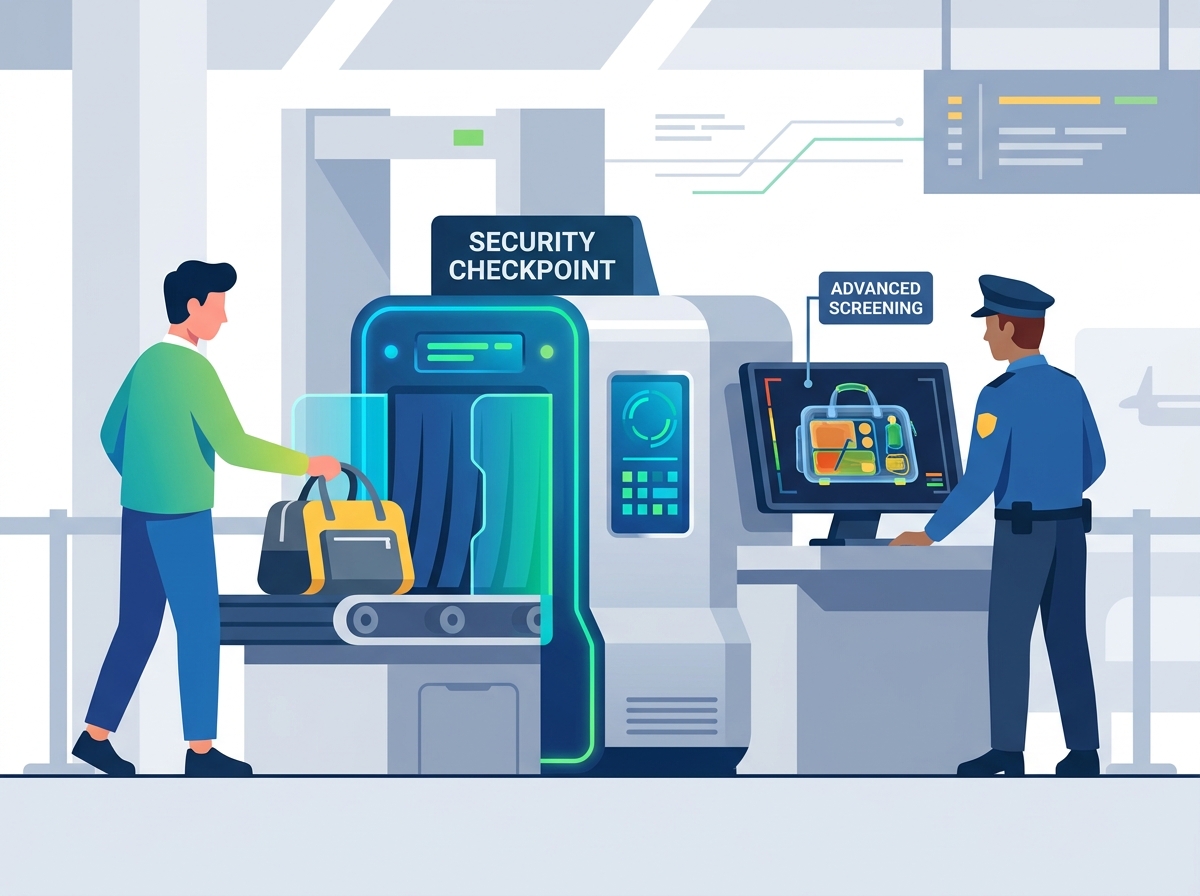
Standard single-energy X-ray systems represent the baseline of legacy screening. These machines operate by emitting a single spectrum of X-ray energy through an object to a detector array. The resulting image is based entirely on density. Denser objects absorb more X-rays and appear darker on the screen, while less dense objects allow more X-rays to pass through and appear lighter.
The critical limitation is that single-energy systems fail to distinguish between different materials of similar thicknesses. A thick block of organic material like cheese or soap might exhibit the same density profile as a block of plastic explosives. This lack of material discrimination leads to unacceptably high false alarm rates in modern aviation environments. Operators cannot confidently clear a bag based on a grayscale density map alone.
Dual-Energy technology solves the material discrimination problem by utilizing two distinct energy spectrums to measure X-ray attenuation. The machine fires a broad spectrum of X-rays, and the detectors separate the high-energy and low-energy beams. By comparing the attenuation rates at these two energy levels, the system's software calculates the effective atomic number of the scanned objects.
Low Energy Measurement: At lower energy levels, photoelectric absorption is the dominant atomic interaction. The system measures how much energy is absorbed by the object.
High Energy Measurement: At higher energy levels, Compton scattering dominates. The system measures the scatter trajectory of the photons.
Atomic Number Calculation: The software cross-references these two measurements to determine the exact effective atomic number (Z-eff) of the material.
This calculation allows the system to apply standard material color-coding protocols. Organic materials, which have low atomic numbers (like plastics, food, and explosives), are colored orange. Inorganic materials with higher atomic numbers (like steel and glass) are colored blue. Mixed materials or light metals (like aluminum) appear green. This color-coding drastically improves threat identification, allowing operators to quickly spot organic anomalies hidden among inorganic items.
Computed Tomography (CT) technology has migrated from the medical field into aviation security, fundamentally changing checkpoint dynamics. A CT scanner features a rotating gantry housing an X-ray source and detector array. As the bag moves along the conveyor, the gantry spins at high speeds, capturing hundreds of projection images from every angle. Powerful computers reconstruct this data into a precise 3D volumetric image.
Operators can rotate the image 360 degrees on their monitors, virtually unpacking the bag without opening it. CT systems use Hounsfield Units to measure precise density variations in 3D space. This level of detail automates liquid explosive detection with extreme accuracy. The primary operational advantage is profound: CT technology allows passengers to leave liquids, aerosols, gels, and large electronics inside their bags. Eliminating the divestment process removes the largest friction point at the checkpoint, vastly improving passenger flow.
It is important to clarify the operational boundary between cabinet X-Ray Scanner Machines used for baggage and active personnel screening technologies. Historically, ionizing X-ray backscatter systems were used for passenger screening. These were phased out due to strict radiation safety regulations and public privacy concerns regarding anatomical imaging.
Modern checkpoints have transitioned to non-ionizing Millimeter Wave technology for personnel. These systems bounce harmless electromagnetic waves off the body. They utilize Automated Target Recognition to process the data, displaying generic, cartoon-like silhouettes with highlighted threat areas instead of raw anatomical images. This resolves privacy issues while maintaining a high probability of detection for concealed non-metallic threats.

Technical benchmarks for image quality dictate a machine's effectiveness. Wire resolution is a critical metric, measured in American Wire Gauge (AWG). A system capable of 40 AWG resolution can display a wire as thin as a human hair, which is vital for detecting detonator components. Spatial resolution measures the ability to distinguish between two closely placed objects.
Steel penetration specifications typically range from 30mm to over 40mm. High penetration indicates a powerful generator and sensitive detector array. Dual-energy algorithms utilize these metrics to isolate low-density organic threats hidden behind dense metallic shields, ensuring nothing is obscured. If a machine cannot penetrate a dense object, it will trigger a dark alarm, forcing a manual search.
Specification Metric | Standard Requirement | High-Performance Standard |
|---|---|---|
Wire Resolution (AWG) | 38 AWG | 40+ AWG |
Steel Penetration | 30mm - 32mm | 38mm - 42mm |
Spatial Resolution | 1.0mm Horizontal / Vertical | 0.8mm Horizontal / Vertical |
Standard conveyor belt speeds for traditional 2D systems range from 0.20 to 0.24 meters per second. This speed correlates directly to the theoretical bags-per-hour capacity of the lane. 3D CT scanning systems sometimes feature physically slower belt speeds due to the time required for the rotating gantry to capture volumetric data.
The overall checkpoint throughput actually increases with CT systems. The reduction in secondary manual searches and the elimination of passenger divestment more than offset the slightly slower belt speed, resulting in a higher net processing rate. A lane that never stops moving processes more passengers than a fast lane that constantly halts for manual bag checks.
Physical realities dictate procurement options. CT systems are significantly heavier and larger than traditional 2D scanners. Facilities must verify floor loading limits and spatial constraints before installation. A standard 2D scanner might weigh 500 kg, while a full-size CT scanner can exceed 1500 kg, often requiring structural floor reinforcement in older terminals.
Modern X-Ray Scanner Machines rarely operate in isolation. They must integrate seamlessly with Automated Screening Lanes (ASL). This includes integration with motorized rollers, automatic diverters for suspect bags, and automated tray return systems. The physical footprint must accommodate these peripheral systems to maximize lane efficiency. If the scanner's software cannot communicate with the ASL programmable logic controllers, the diverter gates will fail to route suspect bags correctly.
Hardware is only half the equation. Automated Threat Recognition and AI-assisted screening software are essential for identifying firearms, knives, and specific explosive profiles. These algorithms draw bounding boxes around suspect items, directing the operator's attention immediately to the threat. This reduces cognitive fatigue and standardizes detection rates across different operator skill levels.
The industry is moving toward Open Architecture software. Open Architecture provides the procurement advantage of integrating third-party AI algorithms into proprietary hardware. This decouples software upgrades from hardware lifecycles, future-proofing the checkpoint and allowing airports to deploy the latest threat detection models without replacing the physical machine. Facilities can swap out detection algorithms as new threats emerge without being locked into a single vendor's software ecosystem.

Procurement teams must verify vendor claims against official certification databases. Equipment must appear on the TSA Qualified Products List or hold ECAC Standard 3 certification for cabin baggage screening. Purchasing "certification-pending" equipment carries immense strategic risk.
If the equipment fails final certification, it cannot be legally operated in a primary screening capacity, resulting in stranded assets and compromised security lanes. Always demand verifiable proof of current regulatory compliance. Request the official certification letters from the regulatory bodies, not just marketing brochures from the manufacturer.
Cabinet X-Ray Scanner Machines are designed to be entirely safe for operators and passengers. They feature heavy lead curtains at the entry and exit tunnels and lead-lined steel cabinets to ensure zero radiation leakage. These designs adhere strictly to FDA/CDRH standards (21 CFR 1020.40).
International occupational safety standards mandate maximum permissible radiation doses for operators and bypassers. Routine radiation surveys and interlock switches ensure these strict safety thresholds are never breached. If an access panel is opened during operation, the interlock switch instantly cuts power to the high-voltage generator, immediately halting X-ray production.
Transitioning security screeners from interpreting flat 2D Dual-Energy images to manipulating 3D volumetric data requires comprehensive training. The learning curve involves mastering the user interface to slice through images and isolate specific layers. Ergonomic monitor placement and intuitive controls are vital to reduce operator fatigue during long shifts.
Threat Image Projection software is used to continuously monitor operator performance. TIP randomly superimposes fictional threat items onto actual passenger bags during live operations. If the operator flags the bag, the system registers a pass; if they miss it, the system logs a failure and mandates retraining. This keeps cognitive alertness high and provides management with quantifiable data on screener effectiveness.
The storage of personal baggage images raises valid passenger and regulatory privacy concerns. Modern scanner software implements automated image deletion protocols to comply with data privacy regulations like GDPR. Images are typically held in a short-term buffer only long enough for the operator to clear the bag or for a secondary search to be completed.
Once the bag exits the checkpoint, the image is automatically purged from the local system unless specifically flagged for law enforcement evidence. Facilities must ensure their standard operating procedures align with these automated deletion protocols to prevent unauthorized archiving of passenger belongings.
Modern checkpoints are highly networked. X-Ray Scanner Machines often connect to central monitoring rooms or multiplexed screening systems where operators analyze images remotely. This connectivity introduces cybersecurity vulnerabilities that must be mitigated at the network architecture level.
Essential cybersecurity standards must be enforced, including secure AES-256 encryption protocols for raw image data transmission across the local network. Role-based access control ensures that only authorized personnel can access diagnostic menus, alter detection algorithms, or extract system logs. Protecting the integrity of the screening process from internal and external tampering is just as critical as physical threat detection.
Airport X-Ray Scanner Machines have become the foundation of modern aviation security, enabling airports to improve threat detection, accelerate passenger screening, and meet increasingly stringent international security standards. Investing in advanced screening technologies helps airports enhance operational efficiency while delivering a safer travel experience.
At Eastimage, we specialize in advanced X-ray security inspection systems for airports, aviation security, customs, and critical infrastructure worldwide. Our innovative screening technologies and professional support help customers improve checkpoint efficiency, strengthen threat detection capabilities, and achieve long-term regulatory compliance.
Before selecting Airport X-Ray Scanner Machines, evaluate your passenger volume, regulatory requirements, checkpoint layout, and future technology upgrade plans to ensure the most efficient and scalable security screening solution.
A: Standard systems use a single energy beam to create images based solely on object density, making it hard to distinguish between materials. Dual-energy systems use two distinct energy levels to calculate the atomic number of objects, allowing them to differentiate between organic, inorganic, and metallic materials and display them in specific colors.
A: It measures how X-rays attenuate at high and low energy spectrums. Low energies measure photoelectric absorption, while high energies measure Compton scattering. Comparing these two values allows the system's algorithm to calculate the effective atomic number and identify the material type.
A: Cabinet X-ray scanners do not damage electronic devices, hard drives, or modern medical implants. However, the radiation can damage unprocessed, high-speed analog camera film. Passengers carrying specialized film should request a manual inspection.
A: CT scanners create 3D volumetric images that allow operators to virtually inspect a bag from any angle. This advanced detection capability means passengers no longer need to remove liquids, gels, or large electronics from their bags, drastically speeding up the line.
A: Cabinet scanners are heavily shielded with lead-lined walls and lead curtains. They must meet strict FDA and international safety standards, ensuring zero radiation leakage. Operators and passengers are completely safe from radiation exposure during normal operation.
A: It depends on the system's architecture. Modern machines with Open Architecture support third-party AI integration. Older legacy systems often have closed, proprietary software that cannot process modern automated threat recognition algorithms without a complete hardware replacement.