- All
- Product Name
- Product Keyword
- Product Model
- Product Summary
- Product Description
- Multi Field Search
Views: 10 Author: Site Editor Publish Time: 2026-07-22 Origin: Site


High-stakes imaging environments are moving from human-only visual inspection to AI-augmented analysis. Traditional screening operations face severe vulnerabilities. Operator fatigue, cognitive overload, and unrelenting high throughput demands compromise detection accuracy over time. The consequences of false negatives are severe, whether they involve missed threats at aviation security checkpoints or overlooked anomalies in medical diagnostics.
To address these operational bottlenecks, artificial intelligence serves as a mandatory risk-mitigation layer. Integrating computer vision and deep learning directly enhances the baseline capabilities and accuracy of modern X-Ray Scanner Machines. This technological evolution provides a concurrent reading mechanism that flags potential risks in real-time. Human operators can then focus their cognitive resources on verifying complex anomalies rather than scanning for obvious baseline threats.
Augmentation over Automation: AI in X-ray scanning functions best as a concurrent reader or triage tool, significantly reducing human error caused by fatigue, training gaps, or distraction.
Dual-Industry Impact: While the core technology relies on computer vision deep learning, the application diverges sharply between security (autonomous threat detection) and medical (low-dose imaging and diagnostic support).
The False Positive Trade-off: Evaluating AI models requires balancing high sensitivity (catching every anomaly) with specificity (avoiding workflow-crippling false alarms).
Deployment Architecture Matters: The choice between edge-computing (on-device) and cloud-based AI processing dictates system latency, data privacy compliance, and integration costs for X-ray scanner machines.
Table of Contents
Human visual perception predictably degrades over a standard operational shift. Continuous monitoring of complex, overlapping monochromatic or dual-energy images leads to a measurable drop in detection accuracy. An operator reviewing hundreds of scans per hour experiences visual fatigue, reducing their ability to spot subtle density variations or irregular shapes. In aviation security, for example, operators typically rotate off the screen every 20 to 30 minutes specifically to combat this rapid cognitive decline. Despite these administrative controls, the sheer volume of visual data processed during a shift inevitably leads to missed details.
Facilities constantly battle the inherent conflict between processing speed and scan thoroughness. Security checkpoints must clear a specific number of bags per hour to prevent terminal gridlock. Clinical radiology departments face mounting daily patient quotas, often requiring radiologists to interpret hundreds of complex studies per shift. Forcing higher throughput directly limits the time an operator or radiologist can spend analyzing a single image, increasing the probability of critical omissions. When the belt speed increases, the time available for human cognitive processing decreases proportionally.
Monotonous scanning environments create a severe cognitive deficit. Constant cognitive switching and training gaps lead operators to overlook micro-fractures in clinical settings or small, disassembled weapons in security lanes. The human brain naturally filters out repetitive visual data, making it highly susceptible to missing rare but dangerous anomalies. A screener looking at thousands of benign bags containing laptops and shoes may develop a subconscious expectation of safety, causing them to miss a low-density explosive sheet hidden in a laptop compartment.
Successful AI integration requires strictly defined operational criteria. A deployment must demonstrate a measurable reduction in false negatives without degrading existing throughput metrics. The software must integrate seamlessly into established operator workflows, providing clear, actionable alerts rather than overwhelming the user with raw data or complex secondary interfaces. The goal is to elevate the baseline performance of the entire screening operation.
Operational Metric | Human-Only Screening | AI-Assisted Screening |
|---|---|---|
Detection Consistency | Degrades after 20-30 minutes of continuous monitoring | Maintains 100% consistency regardless of shift length |
Throughput Capacity | Limited by human cognitive processing speed | Analyzes images in milliseconds, supporting maximum belt speeds |
Anomaly Recognition | Struggles with cluttered, overlapping dense objects | Digitally isolates and classifies overlapping materials instantly |
Fatigue Impact | High susceptibility to automation bias and visual fatigue | Zero fatigue; acts as a constant secondary verification layer |
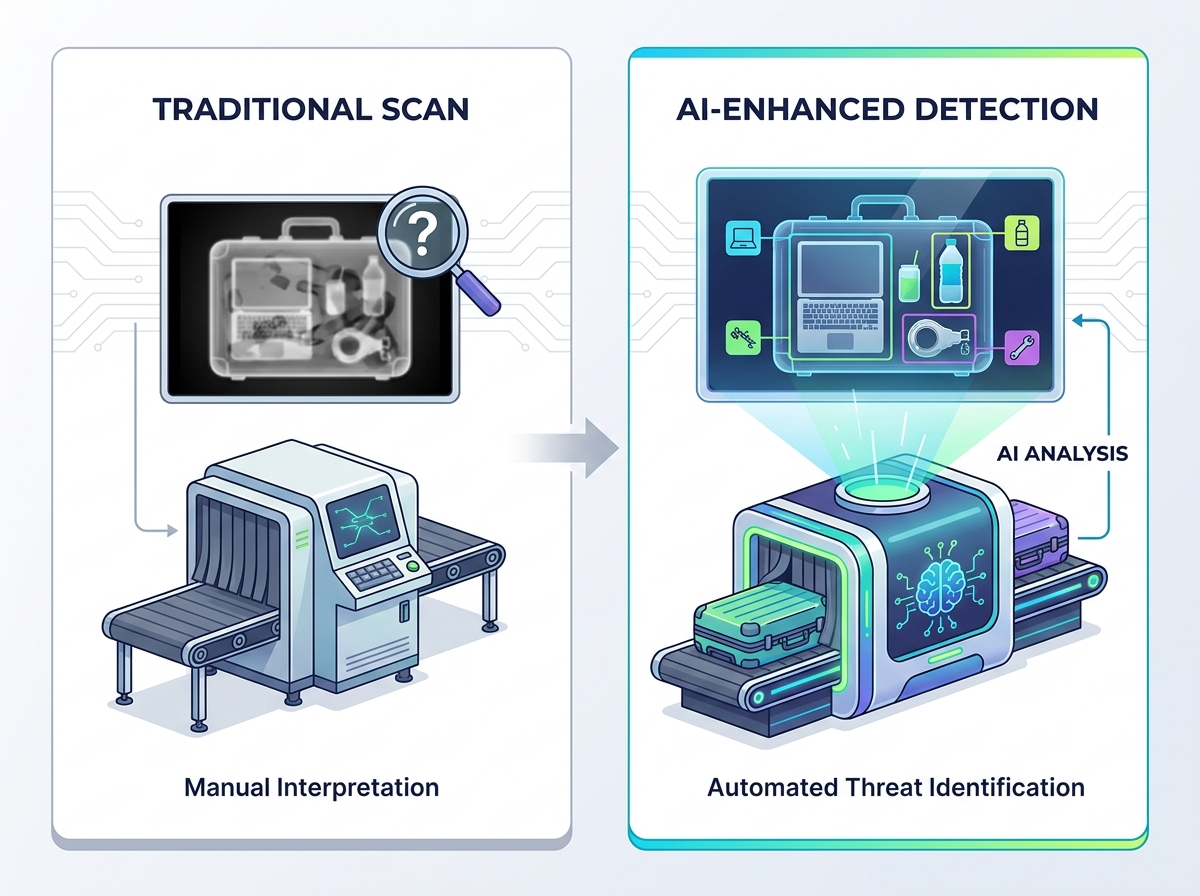
Autonomous Threat Recognition (ATR) algorithms are explicitly trained to identify specific material densities, geometric shapes, and silhouettes. These deep learning models analyze spatial orientation, allowing the system to recognize a threat even if it is positioned at an unconventional angle or partially obscured by surrounding items. By mapping the atomic number and density of scanned objects against a vast database of known threats, ATR provides a highly reliable first pass of the scanned image.
Modern AI systems feature targeted object recognition profiles capable of classifying high-risk threats with extreme precision. These algorithms reliably detect firearms, ammunition, grenades, knives, brass knuckles, and liquid explosives. By continuously updating threat libraries, facilities maintain a robust defense against evolving concealment methods. For instance, if a new type of 3D-printed weapon emerges, the algorithm can be retrained and deployed across the fleet of X-Ray Scanner Machines to recognize the specific polymer density and shape.
Dual-energy systems leverage AI to execute advanced material discrimination. The software cleanly differentiates between organic materials like plastics, narcotics, or explosives, and inorganic materials such as metals and shielding components. This atomic number analysis provides operators with color-coded, highly accurate material classifications. The AI can instantly highlight a block of organic material that matches the density profile of C4, even if it is molded to look like a benign object.
Dense, cluttered bags and heavily packed cargo containers routinely confuse human operators. AI algorithms digitally unpack these complex images, isolating individual items and stripping away visual noise. This capability allows the system to evaluate distinct objects within a chaotic environment, drastically reducing the need for manual secondary inspections. When a cargo pallet contains hundreds of mixed items, the AI can segment the image and analyze each component individually in a fraction of a second.

Automated pathological detection assists clinicians in identifying acute conditions rapidly. AI models analyze chest scans for anomalies such as pneumothorax, consolidations, or nodules. In musculoskeletal imaging, the software highlights subtle fractures, calculates precise bone age, and performs automated anatomical measurements, ensuring diagnostic consistency across different practitioners. A hairline fracture in the scaphoid bone, often missed during a rushed emergency room shift, is immediately flagged by the algorithm for closer review.
Patient safety heavily relies on minimizing radiation exposure. AI integration allows modern X-Ray Scanner Machines to capture high-definition images using significantly lower radiation doses. Deep learning models compensate for the reduced physical signal by intelligently enhancing the resulting image. This is particularly vital in pediatric radiology, where minimizing lifetime radiation exposure is a primary clinical objective.
Image reconstruction algorithms process the raw, noisy sensor outputs generated during low-dose scans. By applying trained neural networks, the system filters out artifact noise and reconstructs clear, diagnostic-grade images. This computational enhancement bridges the gap between low radiation input and high-fidelity visual output. The AI essentially predicts what the image should look like at a full radiation dose based on the sparse data collected during the low-dose scan.
Clinical triage and prioritization workflows benefit immensely from AI integration. Algorithms automatically flag critical, life-threatening findings directly at the point of capture. These high-risk cases are immediately moved to the top of the radiologist's queue, accelerating intervention times for acute trauma or severe respiratory distress. Instead of reading scans in a strict first-in, first-out order, the radiologist is directed to the most urgent cases immediately.

Deploying AI requires navigating the sensitivity and specificity matrix. High sensitivity ensures the system catches nearly every anomaly, but often results in a high volume of false positives. Facilities must weigh the operational cost of unnecessary manual bag checks or clinical over-testing against the catastrophic, unacceptable risk of a false negative. A system tuned to flag every dense organic mass will catch all explosives but will also flag every block of cheese or dense chocolate, bringing the screening lane to a halt.
Procurement teams must evaluate validation metrics rigorously. Analyzing Receiver Operating Characteristic (ROC) curves and Area Under the Curve (AUC) metrics provides a mathematical baseline for algorithmic performance. These metrics reveal how well the system distinguishes between actual threats and benign objects under real-world conditions. An AUC score approaching 1.0 indicates a highly accurate model, while a score closer to 0.5 indicates the model is no better than random guessing.
Organizations must choose between continuous learning models and locked algorithms. Static, locked models offer predictable performance and are significantly easier to regulate and certify. Adaptive models learn from local data over time, potentially improving accuracy, but introduce risks of algorithmic drift and complex compliance challenges. Most highly regulated environments currently mandate locked algorithms to ensure consistent, verifiable performance across all deployed units.
Effective UI/UX integration dictates operator adoption. AI findings must be presented clearly using dynamic bounding boxes, heat maps, or probability scores. Poorly designed interfaces create visual clutter, actively hindering the operator's ability to assess the primary image and slowing down the screening lane. If the AI draws thick, opaque boxes over the image, it obscures the very details the operator needs to verify the threat.
AI should function strictly as a decision support mechanism. Framing the technology as a second set of eyes prompts the operator to review specific, high-risk zones. The human operator retains final authority, utilizing the AI's spatial highlights to make faster, more accurate determinations. The interface should allow the operator to toggle the AI overlay on and off instantly to compare the raw image with the algorithmic analysis.
Integrating third-party AI software into legacy equipment presents distinct challenges. Retrofitting requires evaluating API compatibility, network latency, and the processing limitations of older hardware. While cost-effective upfront, legacy integrations often suffer from delayed image rendering and restricted feature sets. To properly evaluate a retrofit, facilities should follow these steps:
Audit the existing fleet to determine the exact make, model, and software version of all deployed scanners.
Verify that the legacy scanners have open APIs or accessible image output streams that the third-party AI can ingest.
Test the network infrastructure to ensure it can handle the continuous transmission of uncompressed image files to the local AI server.
Measure the round-trip latency from image capture to AI overlay rendering; any delay over 500 milliseconds will disrupt operator workflow.
Assess the physical space available at the checkpoint to house additional edge-computing hardware if the legacy scanners lack internal processing power.
Purchasing modern X-Ray Scanner Machines with native AI architecture provides superior performance. These systems feature purpose-built, embedded graphics processing units (GPUs) and integrated AI engines. Native architecture guarantees ultra-low latency, ensuring the AI analysis appears simultaneously with the initial image render. The hardware and software are co-developed, eliminating integration friction and maximizing the efficiency of the detection algorithms.
Clinical diagnostic algorithms require strict medical compliance. Systems must secure FDA clearance, typically through the 510(k) pathway, or obtain regional equivalents like the CE mark in Europe. These certifications validate that the AI performs safely and effectively within specific diagnostic parameters. Using uncertified algorithms in a clinical setting exposes the facility to massive liability and endangers patient health.
Security deployments must adhere to rigorous aviation and infrastructure standards. Algorithms detecting explosives or weapons require certification from bodies like the TSA or the European Civil Aviation Conference (ECAC). Operating uncertified algorithms in regulated checkpoints violates federal mandates and compromises facility security. Procurement teams must demand documentation proving the specific algorithm version has passed these stringent governmental testing protocols.
Edge computing processes data directly on the local machine. This on-premise architecture delivers ultra-low latency and offline capability. Localized processing ensures strict data sovereignty, keeping sensitive patient health information or classified security images entirely within the facility's secure network. For military bases or hospitals bound by HIPAA regulations, edge computing is often the only legally viable deployment method.
Cloud-based processing offers massive computational power and centralized algorithm updates. However, streaming high-resolution images to external servers consumes significant network bandwidth. Cloud architectures introduce latency dependencies and potential data transmission vulnerabilities, requiring robust end-to-end encryption protocols. If the facility's internet connection drops, a cloud-dependent scanner loses all AI capabilities, forcing operators to revert to manual screening.

Operators frequently struggle with the "black box" nature of deep learning. If users do not understand how the algorithm reaches its conclusions, they may succumb to automation bias—blindly trusting the machine—or ignore the alerts entirely. Both extremes degrade overall screening effectiveness. When an operator ignores a valid alert because they don't understand why the AI flagged a seemingly benign object, the entire system fails.
Implementing explainable AI features mitigates this risk. Systems that provide feature maps or highlight specific pixel clusters help operators understand the algorithm's logic. Mandating rigorous, ongoing training reinforces the AI's role as a supportive tool, ensuring operators maintain active engagement during the screening process. Training should include reviewing false positives so operators learn the algorithm's specific blind spots and operational quirks.
Introducing automated detection disrupts established workflows. Staff accustomed to traditional screening methods often experience friction when adapting to new interfaces, leading to temporary reductions in throughput and localized resistance to the technology. Operators may feel the AI is there to replace them or monitor their performance, leading to low morale and poor adoption rates.
Facilities should execute phased rollouts and parallel testing. Running the AI silently in the background allows management to evaluate accuracy without disrupting the live lane. Establishing clear standard operating procedures (SOPs) for handling AI-flagged anomalies ensures staff know exactly how to proceed when an alert occurs. Clear communication regarding the AI's role as an assistive tool, rather than a replacement, is necessary for smooth change management.
Deploying advanced detection models demands specific infrastructure capabilities. Hidden bottlenecks often emerge regarding software licensing structures, necessary hardware upgrades, and network bandwidth limitations. Older facilities may lack the cabling or server capacity to support high-speed image data transfer. Upgrading a checkpoint is not just about installing new software; it requires a holistic review of the physical and digital environment.
Conducting comprehensive infrastructure audits during the procurement phase prevents deployment stalls. Facilities must map out data flow requirements, evaluate local GPU capacities, and ensure network switches can handle the sustained load of continuous image processing between the scanners and the local servers. Failing to upgrade a standard network switch can result in image rendering delays that completely negate the speed benefits of the AI system.
AI-powered X-Ray Scanner Machines are transforming modern security screening and medical imaging by improving detection accuracy, increasing operational efficiency, and supporting more consistent decision-making. Integrating AI with advanced X-ray technology enables organizations to reduce human error while maintaining high throughput and reliable inspection performance.
At Eastimage, we specialize in intelligent X-ray security inspection solutions that combine advanced imaging technology with AI-driven detection capabilities. Our professional team provides innovative screening systems and comprehensive technical support to help customers improve security performance, operational efficiency, and regulatory compliance.
Before deploying AI-powered X-Ray Scanner Machines, evaluate your operational requirements, existing infrastructure, data security policies, and long-term upgrade plans to ensure the most effective and future-ready screening solution.
A: Yes. Many existing machines can be retrofitted using third-party software integrations. However, success depends on the legacy hardware's API accessibility and local processing power. Older units may require external edge-computing servers to handle the AI workload without introducing unacceptable image rendering latency.
A: In security, AI detects firearms, ammunition, grenades, knives, brass knuckles, and specific explosive densities. In medical settings, algorithms identify acute pathologies like pneumothorax, consolidations, nodules, musculoskeletal fractures, and can calculate precise bone age measurements.
A: AI enables low-dose imaging by utilizing deep learning image reconstruction algorithms. The scanner captures an image using a fraction of the standard radiation dose, resulting in a noisy raw file. The AI then filters the noise and reconstructs a high-definition, diagnostic-grade image.
A: No. AI operates under a "human-in-the-loop" framework. It acts as a concurrent reader and decision support tool, highlighting potential anomalies. The human operator retains final authority, using the AI's triage data to make faster, more accurate final determinations.
A: If an object falls outside the algorithm's trained parameters or fails to meet specific confidence thresholds, the system defaults to human protocols. It will either flag the item as an unknown dense anomaly or leave it unmarked, requiring the operator to apply standard visual inspection training.
A: False positives trigger standard secondary inspection workflows. The bag is diverted for manual search or explosive trace detection. Facilities manage false positive rates by tuning the algorithm's sensitivity thresholds to balance threat detection with acceptable operational throughput.
A: Network requirements depend on the architecture. Edge computing processes data locally on the machine, requiring minimal external bandwidth. Cloud-based analysis requires robust, high-speed, and heavily encrypted broadband connections to transmit high-resolution images to external servers continuously without causing lane delays.