
- All
- Product Name
- Product Keyword
- Product Model
- Product Summary
- Product Description
- Multi Field Search
Views: 7 Author: Site Editor Publish Time: 2026-07-24 Origin: Site


Unplanned downtime in diagnostic imaging or security screening creates immediate operational bottlenecks and steep emergency repair costs. When a scanner goes offline, throughput halts entirely, forcing facility managers to scramble for alternative screening methods or reroute patients. The natural degradation of high-voltage components, such as X-ray tubes, and sensitive digital detectors inevitably leads to compromised image quality, false readings, and severe regulatory compliance risks. Ignoring these wear patterns guarantees failure at the worst possible moment. Shifting from a reactive break-fix approach to a structured, proactive preventive maintenance framework maximizes the asset lifecycle and guarantees continuous compliance for your X-Ray Scanner Machines. Implementing daily checks and professional servicing routines stops minor calibration drift from becoming a catastrophic hardware failure.

Baseline Protection: Daily visual inspections and weekly calibration checks prevent the majority of baseline imaging errors and mechanical failures.
Professional PM Standards: Bi-annual professional preventive maintenance is the industry baseline for heavily utilized fixed X-Ray Scanner Machines.
Component Vulnerability: Protecting digital detector panels from physical impact and managing system thermals yield the highest ROI in equipment longevity.
Shielding & Safety Audits: Maintaining the integrity of radiation shielding (lead curtains, collimators, and protective barriers) is a non-negotiable legal and operational requirement.
Contract Evaluation: Effective service contracts must be evaluated on strict SLA response times, specific parts coverage (especially glassware/tubes), and compliance documentation support.
Table of Contents
Successful maintenance extends far beyond simply keeping the machine powered on. It requires a comprehensive strategy that ensures optimal performance, safety, and longevity. Defining clear success criteria helps organizations measure the true return on investment for their maintenance programs. You need to track specific metrics that prove your maintenance routines actually prevent failures rather than just documenting them.
The operational cost of an offline scanner accumulates rapidly per hour or day. Predictive maintenance flattens the failure curve by identifying potential issues before they cause system outages. Regular inspections and timely parts replacement prevent sudden breakdowns, ensuring continuous throughput in busy environments. When a security checkpoint loses a scanner, passenger or cargo queues back up instantly, requiring additional manual labor to clear the backlog. In a medical setting, a downed machine means canceled appointments and delayed diagnoses. By tracking component wear rates, technicians can schedule replacements during off-hours, completely avoiding the chaos of a mid-shift failure.
Maximizing the operational life of X-ray tubes, generators, and digital detector arrays significantly impacts financial performance. Proper thermal management and calibration reduce stress on these expensive components. Extending their lifespan delays major capital expenditures and improves the overall lifecycle value of the equipment. An X-ray tube running hot due to clogged cooling fans will burn out months or years before its rated lifespan. Routine cleaning of intake vents and verification of coolant levels directly translate to extended hardware viability. You are actively protecting your most expensive replacement parts through basic environmental control.
Passing strict state and federal radiation safety audits requires meticulous maintenance and verifiable performance logs. Regular testing confirms that radiation levels remain within safe limits. Maintaining detailed records of all maintenance activities demonstrates compliance and protects organizations from costly fines or operational shutdowns. Inspectors look for a documented history of calibration and shielding checks. If you cannot produce a continuous log of phantom tests and scatter radiation surveys, you risk immediate operational suspension. A proactive maintenance schedule bakes these compliance checks into the daily and weekly workflow, eliminating the panic of an unannounced audit.
Precise calibration directly connects to minimized artifacting in medical settings and accurate threat detection in security applications. Consistent image quality ensures reliable diagnostics and effective hazard identification. Routine maintenance preserves the accuracy of the imaging system, safeguarding both operational integrity and public safety. A detector panel that has drifted out of calibration might display ghosting or dead pixels, obscuring a critical medical anomaly or a concealed weapon. Regular flat-field calibrations and spatial resolution checks guarantee that the image on the monitor accurately represents the scanned object.
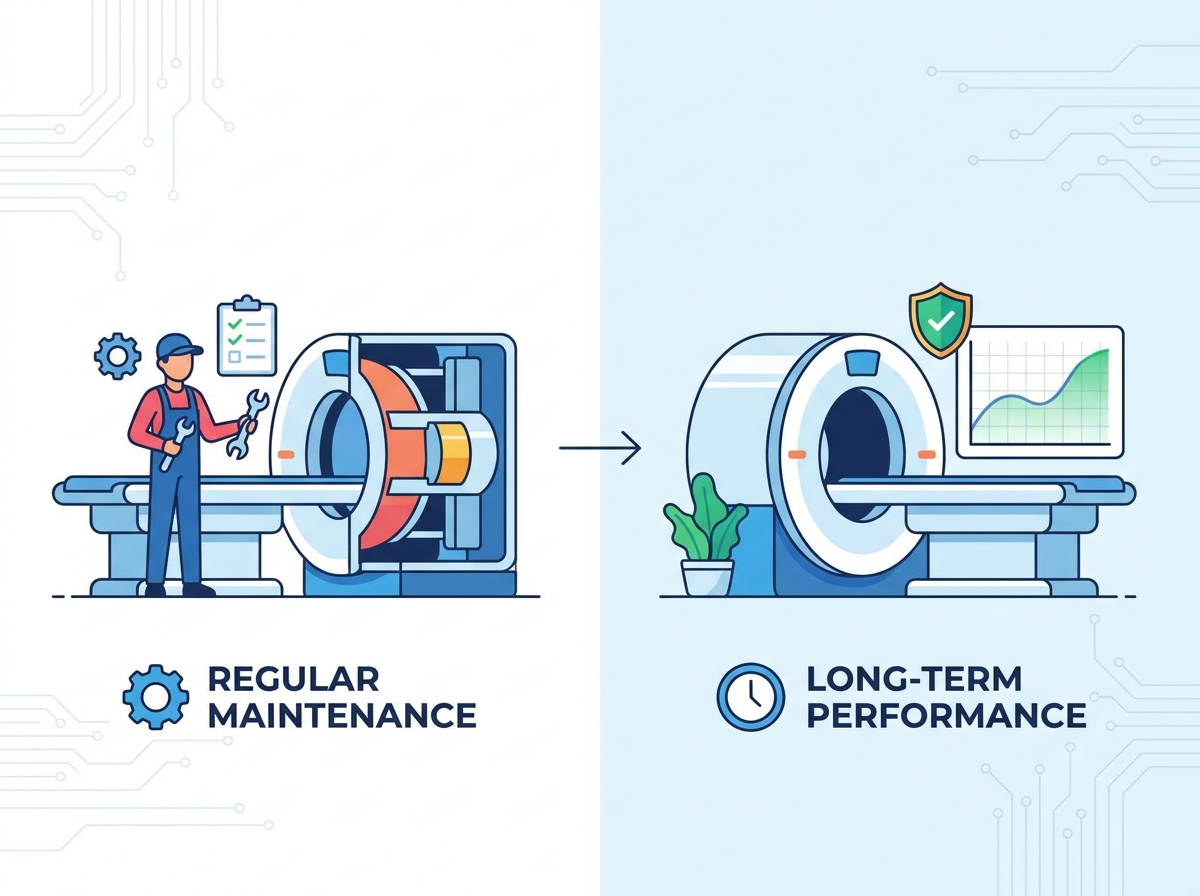
Breaking down maintenance responsibilities by frequency and technical requirement ensures comprehensive coverage. A balanced approach combines daily in-house checks with scheduled professional servicing to maintain peak performance. Facility operators handle the surface-level operational checks, while certified technicians manage the high-voltage and deep-system diagnostics.
Daily routines performed by operators form the foundation of preventive maintenance. These simple checks catch obvious issues early before they escalate into major mechanical faults.
Perform visual inspections of all external housings, power cables, and structural supports.
Verify radiation warning indicator lights and test physical emergency stop buttons.
Inspect physical safety barriers, checking lead shielding curtains for tears or confirming the availability of intact personal protective equipment.
Execute approved surface cleaning and disinfection protocols to prevent debris buildup.
More detailed functional verifications should occur on a weekly or monthly basis to monitor system health and calibration. These tasks require a slightly higher level of technical familiarity but are still manageable by trained internal staff.
Conduct phantom testing to monitor spatial resolution, contrast-to-noise ratio, and artifact presence.
Verify monitor display quality, calibration settings, and automated software diagnostic alerts.
Inspect conveyor belt tension, tracking alignment, and optical sensor performance for security configurations.
Check wheel locks, structural joint stability, and battery charge retention for mobile or portable units.
Two professional preventive maintenance visits per year are recommended for fixed units. These visits involve deep-dive assessments that internal staff typically cannot perform. Technicians execute generator calibration, mechanical stress tests, and comprehensive radiation leakage testing to ensure long-term reliability. During a PM visit, the technician will open the main housing, inspect the high-voltage cables for dielectric grease degradation, and verify the anode rotation speed. They also perform a full software diagnostic sweep to identify any hidden error codes that the daily operator interface might not display.
Connecting specific hardware care to long-term performance outcomes highlights the importance of targeted maintenance strategies. Protecting sensitive components and managing environmental factors are necessary for sustaining equipment functionality. You must treat the environment around the scanner with as much care as the scanner itself.
Digital detectors are highly sensitive and expensive. Strict guidelines on handling protocols, weight limits, and avoiding direct pressure on the detector surface must be enforced. Utilizing protective covers and secure docking stations during transit or storage prevents physical damage to portable detector panels. A single drop can shatter the internal glass substrate of a flat panel detector, resulting in an immediate five-figure replacement cost. Staff must be trained to never carry a detector by its corner and to always use weight-bearing protective grids when scanning heavy objects.

Ambient room temperature, internal cooling fans, and dust accumulation significantly impact generators and high-voltage electronic boards. Proper ventilation and regular cleaning prevent overheating. Dedicated power conditioners or Uninterruptible Power Supplies (UPS) are necessary to protect sensitive computer systems from damaging voltage spikes. X-ray generators draw massive amounts of power in short bursts. If the facility's power grid fluctuates, it can fry the generator's control boards. Installing a robust UPS ensures clean, consistent power delivery and provides enough battery backup to safely shut down the system during a total power failure.
Moving parts require regular inspection and lubrication to prevent premature wear and failure. Mechanical binding forces motors to work harder, leading to early burnout.
System Type | Key Mechanical Components | Maintenance Action |
|---|---|---|
Medical Systems | Overhead tube suspension cranes, motorized patient tables, alignment tracks | Inspect for smooth travel, lubricate bearings, check cable tension to prevent motor burnout and structural wear. |
Security Systems | Conveyor rollers, drive motors, optical sensors | Focus on conveyor belt tracking, drive motor lubrication, and optical sensor alignment to ensure smooth operation. |
Maintaining radiation safety is a strict operational requirement. Establish inspection parameters for collimator blade alignment to prevent unnecessary radiation exposure. Detail the maintenance and testing of lead glass window seals, shielding panels, and entry/exit curtains to prevent radiation leakage. Over time, the lead-impregnated vinyl curtains on security scanners become brittle and tear. A torn curtain allows scatter radiation to escape into the operator's environment. These curtains must be inspected daily and replaced immediately if any gaps or tears are discovered.
Procuring and evaluating third-party maintenance support requires a clear understanding of value-influencing factors. Selecting the right contract ensures adequate coverage and minimizes financial risk. You need to know exactly what you are paying for and what is excluded before signing any service agreement.
Original Equipment Manufacturer (OEM) contracts often guarantee proprietary parts but come at a higher cost. Independent Service Organizations (ISOs) offer multi-vendor flexibility and potential cost savings. Weighing these trade-offs helps determine the best fit for your operational needs and budget constraints. If your facility operates a mixed fleet of scanners from different manufacturers, an ISO can consolidate your service contracts into a single agreement. However, if you are running the latest generation of a highly specialized medical scanner, the OEM might be the only entity with access to the necessary diagnostic software and proprietary replacement parts.
Service Level Agreements (SLAs) must define acceptable parameters for support. Demand guaranteed response times, remote diagnostic capabilities, and parts availability guarantees. Establishing minimum uptime percentages, such as 98% uptime SLAs, ensures that service providers are accountable for system availability. A contract that promises a "best effort" response time is useless during a critical failure. You need hard commitments: a four-hour on-site response time for emergencies and guaranteed next-day delivery for standard replacement parts.
Scrutinize contracts for specific inclusions and exclusions. Pay close attention to "glassware" (X-ray tube) coverage, detector drop protection, travel fee stipulations, and emergency weekend labor charges. Understanding these details prevents unexpected expenses during critical repair situations. Many basic contracts exclude the X-ray tube, treating it as a consumable item. Given that a replacement tube can cost tens of thousands of dollars, you must explicitly verify whether glassware is prorated, fully covered, or entirely excluded from your agreement.

Executing a maintenance strategy involves navigating common points of failure. Addressing these realities proactively ensures the success of the maintenance program. A plan on paper means nothing if the staff fails to execute it consistently.
Manual record-keeping often leads to missing data and compliance issues. Implement automated digital logging and centralized Computerized Maintenance Management System (CMMS) tracking for all QA tests, radiation surveys, and PM visits. This simplifies compliance audits and ensures accurate historical records. When an inspector asks for the last six months of daily calibration logs, handing them a disorganized binder full of missing signatures is a guaranteed failure. A CMMS forces operators to complete digital checklists before the machine can be unlocked for daily use.
Improper handling frequently causes equipment damage. Mandate continuous, documented handling training for all staff. Focus specifically on detector drops, cable management, and proper system shutdown procedures to minimize operator-induced failures. Running over a detector cable with a mobile X-ray cart will sever the internal fiber optics, requiring a complete cable assembly replacement. Training must emphasize situational awareness and strict adherence to physical handling protocols.
Outdated software exposes systems to security threats and operational glitches. Ensure service contracts include scheduled patch management, operating system updates, and network isolation protocols for connected X-Ray Scanner Machines to maintain digital integrity. Modern scanners are essentially high-powered computers attached to radiation generators. If they are connected to the facility's main network without proper firewalls, they become prime targets for ransomware attacks. Your maintenance plan must include IT coordination to ensure all imaging software and underlying operating systems receive regular security patches.
Effective maintenance is the key to keeping X-Ray Scanner Machines operating safely, accurately, and efficiently throughout their service life. A proactive maintenance strategy not only reduces unexpected downtime but also improves equipment reliability, regulatory compliance, and long-term operational performance.
At Eastimage, we specialize in advanced X-ray security inspection solutions and professional technical support for customers worldwide. Our experienced team provides reliable screening equipment, maintenance expertise, and customized service solutions to help customers maximize system performance and operational efficiency.
Before upgrading or servicing your X-Ray Scanner Machines, evaluate your daily workload, maintenance schedule, critical component condition, and service support requirements to ensure reliable performance and long-term equipment value.
A: Calibration frequency depends on usage and manufacturer guidelines, but functional verification should occur weekly or monthly, with comprehensive professional calibration performed bi-annually during scheduled preventive maintenance visits.
A: Medical systems focus heavily on precise image resolution, patient table mechanics, and strict dose calibration. Security systems prioritize conveyor belt tracking, high-throughput durability, and optical sensor alignment for continuous operation.
A: A standard PM visit includes generator calibration, mechanical stress tests, radiation leakage testing, internal cleaning, software diagnostics, and verification of all safety interlocks and emergency stops.
A: With proper thermal management, regular calibration, and adherence to warmup procedures, an X-ray tube can last several years, depending heavily on the daily scan volume and specific application.
A: Use only manufacturer-approved, non-abrasive cleaning wipes or solutions. Apply the cleaner to a soft cloth rather than directly onto the panel, and avoid excessive moisture near seams or connection ports.
A: Radiation leakage is checked using specialized survey meters during professional PM visits. Daily visual inspections should confirm that lead curtains, glass seals, and protective panels are free from tears or physical damage.
A: A full-service contract typically covers all parts, labor, and travel for a fixed premium. A shared-risk contract lowers the upfront cost but requires the facility to pay for certain high-cost parts or specific labor scenarios out-of-pocket.